Whether it is surgery recovery, stiff joints, or a senior dog who hesitates at the stairs, a change in mobility can quietly take away the things your pet loves most. If your veterinarian has suggested pet rehabilitation, you may be wondering what that means and why they’re pointing you our way.
At Wheatland Animal Hospital in Naperville, we receive referrals from many local partners, and we’re grateful for the trust that comes with each one. Here’s what you can expect.
What is veterinary rehabilitation?
Think of it as physical therapy for pets. Veterinary rehabilitation is a structured, medically guided program that helps dogs and cats recover from surgery or injury, manage chronic pain, and move more comfortably. It goes well beyond regular walks or playtime, and every plan is built around your pet’s own needs and goals.
What happens when my vet refers my pet for rehab?
When your vet shares why they believe your pet could benefit, reach out to us to set up a rehab evaluation. Prior to your appointment, we’ll request your pet’s medical records, including any recent lab work, X-rays, or other testing, to help us understand their medical history. If additional testing is needed, we can perform it here at our hospital.
We’ll start with a thorough examination to get a complete picture of how your pet is moving and functioning. From there, we build a plan around your pet’s specific needs and goals, while keeping your veterinarian informed so everyone caring for your pet is on the same page.
Will my pet still see their regular vet?
Yes. Your veterinarian remains your pet’s home base for checkups, vaccines, and everyday care. We’re here to support them with specialized rehabilitation.
Why do Naperville vets refer to Wheatland for rehabilitation?
Many general practices focus on everyday care and partner with specialized rehabilitation teams like Wheatland’s that have the training and equipment for it. Since 2018, rehabilitation has been an integral part of our practice, led by our Certified Canine Rehabilitation Practitioners (CCRP) Dr. Christ Dupuis, DVM, CCRP, and Dr. Stephanie Cotto CVT, CCRP.
Our program offers advanced services rarely found at general practices, including:
- Underwater treadmill hydrotherapy, which eases stress on healing joints while rebuilding strength
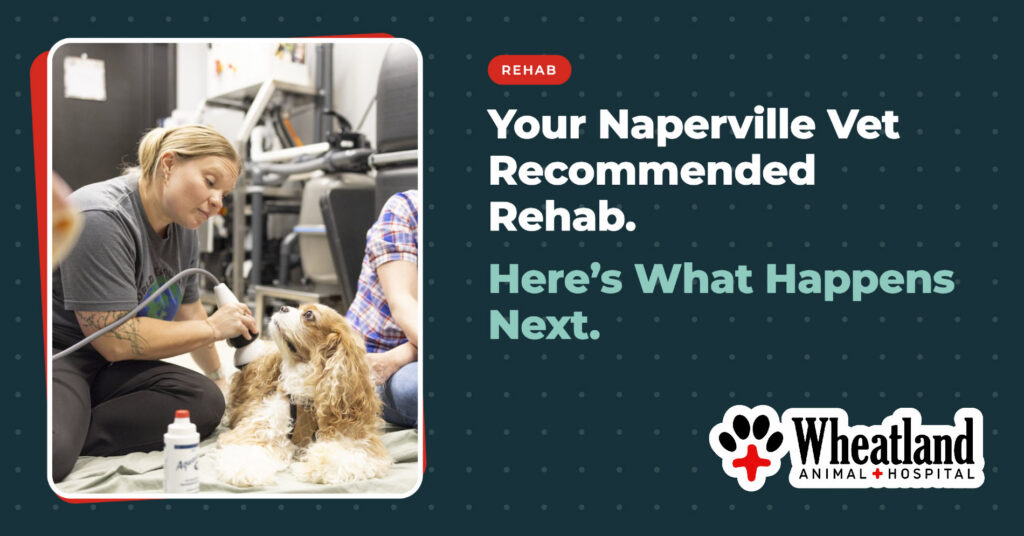
- Laser and shockwave therapy, non-invasive options that support healing and ease pain
- Therapeutic exercise and massage, to restore strength, balance, and comfort
- Stem Cell and Platelet-Rich Plasma (PRP) therapy, to support tissue repair in joints, ligaments, and tendons
Because pain management starts with a thorough exam and in-house diagnostic imaging, we look for the true source of discomfort instead of assuming it’s simply old age. We keep your regular vet in the loop every step of the way, so all of us are working toward the same goals for your pet.
What conditions does rehabilitation help with?
Rehab can support pets recovering from orthopedic surgery such as Tibial Plateau Leveling Osteotomy (TPLO); a cranial cruciate ligament (CCL) tear (one of the most common orthopedic injuries in dogs); and those living with arthritis, hip or elbow dysplasia, or spinal and neurologic conditions like Intervertebral Disc Disease (IVDD). Many senior dogs benefit too. Pain isn’t always obvious, so subtle changes like reduced interaction or a reluctance to jump are worth mentioning.
How often will my pet need rehab sessions?
Every pet’s rehabilitation needs are different. Following your pet’s initial evaluation, we’ll develop a personalized treatment plan based on their condition, goals, and your schedule. Many pets begin with one to two sessions a week, then come in less often as they grow stronger. As your pet progresses, we’ll adjust the frequency of treatments accordingly. After orthopedic surgery, underwater treadmill therapy often starts within 7 to 14 days, depending on healing.
Ready to talk about your pet’s recovery?
Whether your veterinarian recommended rehab or you’ve simply noticed your pet moving differently, our team is happy to talk it through and help you decide what comes next.
Fill out our inquiry form or call us at (630) 904-2020 to request a rehab evaluation.